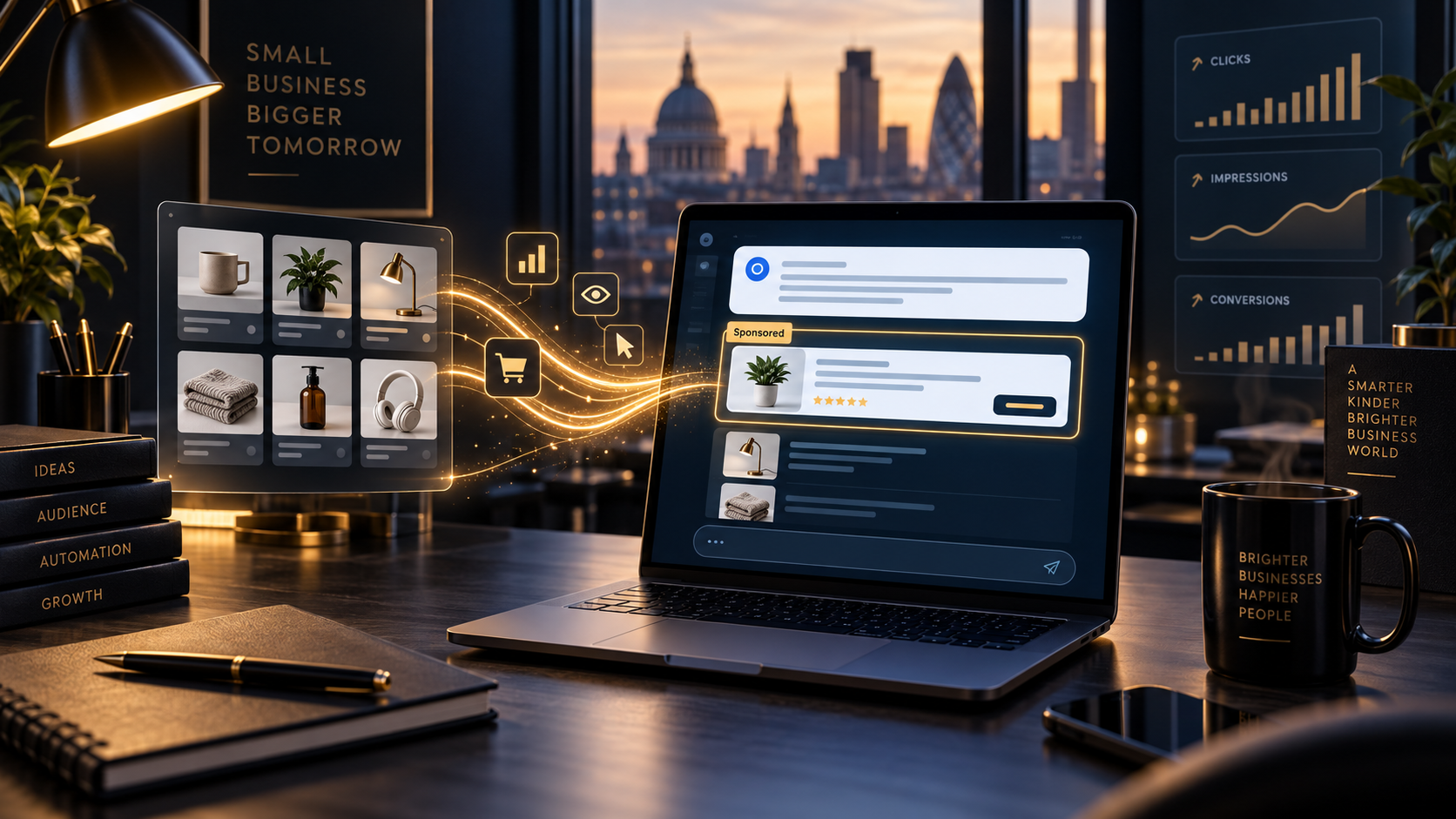
Amazon Ads has opened a pilot that lets selected US advertisers extend campaigns into ChatGPT. The placements can appear as clearly labelled text or image adverts beneath an organic answer, while OpenAI keeps control of the delivery decision.
This is an important advertising development, but it is not a cheap new button that every small business can press today. The launch is US-only, limited to a small group of brands and supplied through Amazon DSP as a managed service.
For a UK small business, the immediate opportunity is preparation rather than spending. Conversational discovery is becoming a real marketing channel, so clear product information, strong offers and reliable measurement will matter before access becomes wider.
What changed with Amazon and ChatGPT ads?
Confirmed fact: Amazon Ads and OpenAI announced the pilot on 10 September 2026. Selected US advertisers can extend Amazon DSP campaigns into ChatGPT, with Delta Vacations named as an early participant.
Amazon provides the buying route and managed campaign support. OpenAI controls whether an eligible advert is delivered and where it appears. The current formats are text and image units shown beneath the organic response with a sponsored label, rather than inserted into the answer itself.
Campaigns can be bought on a cost-per-click or cost-per-thousand-impressions basis. Advertisers in the pilot receive aggregated reporting including impressions, clicks, cost per result, CPM and CPC. Amazon is also offering product-feed adverts that can generate creative assets from a catalogue.
- Available to selected advertisers in the United States
- Bought through Amazon DSP as a managed service
- Delivered by OpenAI's advertising systems
- Shown beneath answers with a sponsored label
- Measured with aggregated click and impression data
Why this matters to small businesses
Our analysis: the news matters less as an advert you can buy this morning and more as evidence that conversational AI is becoming part of the paid customer journey. A person asking for help choosing a product or planning a purchase may now see a relevant paid option at the point of the conversation.
That is different from interrupting somebody who is scrolling. The user has already expressed an intention, problem or preference in their own words. If this type of advertising expands, the strongest campaigns will need to match that context without making the answer feel bought or misleading.
Amazon's involvement also matters because its DSP uses shopping, streaming and browsing signals across Amazon's advertising network. The new pilot connects that established buying system with a conversational surface where people may be researching what to do next.
The opportunity—and who can use it now
Confirmed fact: access is limited. Marketing Dive reports that the launch is a US pilot for selected brands, and Amazon describes the ChatGPT inventory as a managed service. There is no announced self-serve UK rollout in the launch information.
Amazon's general advertising page says managed-service work with an account executive typically requires a minimum spend of $50,000. That is not a published minimum specifically for the ChatGPT pilot, but it is a strong warning that this route is aimed at larger advertisers rather than a local business testing £5 a day.
The near-term opportunity for a smaller seller, agency or creator is to learn how conversational demand is expressed. Customer questions, comparison language and objections can improve product pages, frequently asked questions, email copy and ordinary search or social adverts today—without paying for unavailable inventory.
- Turn real customer questions into clearer product-page answers
- Create separate landing pages for distinct buying problems
- Keep product feeds accurate and complete
- Offer conversational-search audits as a measured service
- Watch for a verified UK or self-serve launch before budgeting
What the adverts do not change
A paid placement does not make a weak offer useful. It cannot repair confusing pricing, poor reviews, slow fulfilment or a landing page that fails to answer the question which produced the click.
OpenAI has said that advertising is separate from ChatGPT answers and that conversations are not shared with marketers. The Amazon integration still gives advertisers aggregated performance reporting, so businesses should judge it as a paid campaign—not as proof that ChatGPT organically recommends their brand.
Organic visibility and paid visibility are different. A sponsored card can win a click while a useful, accurate page can help a brand become a credible source. A sensible strategy prepares for both without presenting advertising as independent endorsement.
The risks and limitations
The first risk is assuming the pilot is open to everyone. It is not. Any agency promising guaranteed access, guaranteed placement or guaranteed sales should be asked for written proof of eligibility and the exact buying arrangement.
The second risk is measurement. A conversational click may look valuable because the user appears interested, but the only useful result is what happens after the click. Track qualified enquiries, purchases, returns and profit—not only impressions or a low CPC.
The third risk is trust. An advert appearing near an AI answer could be mistaken for a recommendation even when it carries a sponsored label. Businesses should use accurate product data, restrained claims and landing pages that make the commercial relationship clear.
- The pilot is US-only and invitation-limited
- Managed service may be unsuitable for small budgets
- Aggregated reporting may not explain every customer journey
- AI-generated product creatives still need human checking
- Sponsored visibility is not an organic endorsement
A practical 30-minute action plan
Choose the product or service that produces your best genuine customer result. Write down the five questions people ask immediately before buying, using the exact language from emails, comments, reviews and sales calls.
Open the matching product page and check whether each question has a specific, easy-to-find answer. Confirm the price, who it is for, what is included, delivery or access details, refund terms and any important limitation. Remove inflated claims that cannot be supported.
Create one tracking link for future AI or conversational campaigns and decide the conversion that matters before spending anything. Save the audit and repeat it monthly. If a UK self-serve option appears, you will have a stronger page and a clean baseline for a small controlled test.
- Collect five real pre-purchase questions
- Answer them clearly on one priority page
- Verify every product-feed field and business claim
- Define one valuable conversion and its tracking method
- Wait for confirmed access before assigning ad budget
COMMON BEGINNER QUESTIONS
Can small businesses buy Amazon's ChatGPT ads now?
Not through an open self-serve launch. The current pilot is limited to selected US advertisers and is offered through Amazon DSP as a managed service.
Where do Amazon-bought adverts appear in ChatGPT?
The launch describes clearly labelled text and image adverts beneath organic ChatGPT responses. OpenAI controls the delivery decision.
Are the ads available in the UK?
No UK availability was announced with the pilot. The launch is limited to selected advertisers in the United States.
Does an advert influence the ChatGPT answer?
OpenAI has said advertising is separate from answers and that conversations are not shared with marketers. A sponsored placement should not be presented as an organic recommendation.
What should a UK business do now?
Improve one priority product page using real pre-purchase questions, verify product data, define a valuable conversion and wait for confirmed access before allocating advertising budget.
Loading comments...